
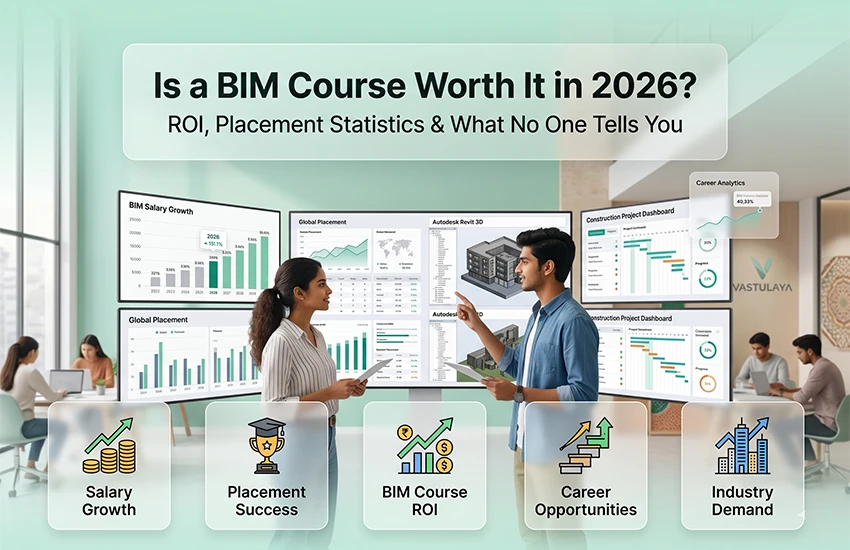
There is an explosion of digital transformation throughout Indian Architecture, Engineering, and Construction (AEC), promising to create significant new capacities to optimize efficiency and increase innovation in India’s nascent construction industry. Massive infrastructure projects, smart city developments, and government mandates are forcing organizations to transition from 2D Drafting to Building Information Modeling (BIM) for Building Construction.
However, many new civil engineering and architecture diploma graduate students still wonder if BIM will be expensive or not in India, as it might feel heavy at first. Many different educational institutions are establishing themselves across the country, making it difficult to determine how much money and time to invest when deciding whether to continue upskilling or not. In this article, we will provide a comprehensive review of current and potential future growth of the BIM market through data pertaining to 2026, actual placement statistics, and the often-unsaid truths within the training industry.
The Difference in Income: BIM Course vs No-BIM Course Salary
By looking at the average starting income of site engineers and architects after completing their traditional college education (between ₹15,000 and ₹25,000 per month), then comparing that with what people earn after an accredited BIM training program (around ₹4.5 LPA to ₹7.5 LPA, depending on the kind of institute they went to), you can clearly see a big income difference. The evidence in the data is proof enough to indicate that if one wants to have the potential for higher-paying work in BIM Management positions, it is absolutely imperative to complete an accredited BIM course of study.
Analysing the Placement Rates and Timeframes for BIM Programs
For anyone considering investing in their education, employment velocity is a metric that will be of great concern. The statistics for the average market BIM course placement rate have been consistent over the past four quarters and are approximately 72% across all generic institutions. On the other hand, when you look at the same data for more reputable institutions with strong corporate contacts and live project portfolios, they show a placement rate above 93%.
Another significant question for most students is ‘how long does it usually take to get a job after completion of a BIM course?’ The approximate timeframe is broken down as follows:
- Top 30% of Candidates: Placed within the last several weeks of the course through campus drives or within 15 days after the end of the course.
- Average Candidates: Placed within 30 to 45 days by either a combination of an active placement cell in their school, and/or by participating in standard interview cycles.
- Remaining Candidates: Generally take between 60 and 90 days to be placed (in some cases, their delay in placement has to do with needing to work on their portfolio or using additional time to practice interviewing).
At Vastulaya, we incorporate extensive mock interviews, global standards training, and extensive placement partnerships to give our graduates a high chance of success in obtaining a job within 30 days after receiving their BIM certification.
Evaluating the BIM Course ROI in India
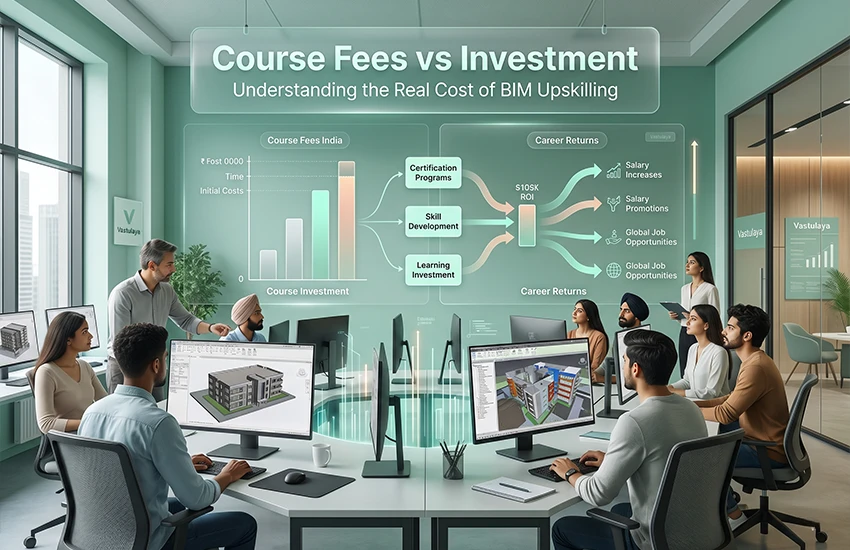
Here is the standard financial comparison based on realistic industry metrics in 2026:
Career Metric | Traditional AEC Path (No BIM) | Upskilled Path (Post Vastulaya BIM Course) |
Average Initial Investment | ₹0 (Direct Entry) | ₹80,000 (Average Course Fee) |
Starting Monthly Salary | ₹18,000 (Approx.) | ₹30,000 – ₹40,000 (Approx.) |
Net 1-Year Earnings | ₹2,16,000 (Approx.) | ₹5,04,000 (Approx.) |
Time to Recoup Course Fee | Less than 4 Months |
Real World Challenges in Industries and Red Flags to Look for in Institutes
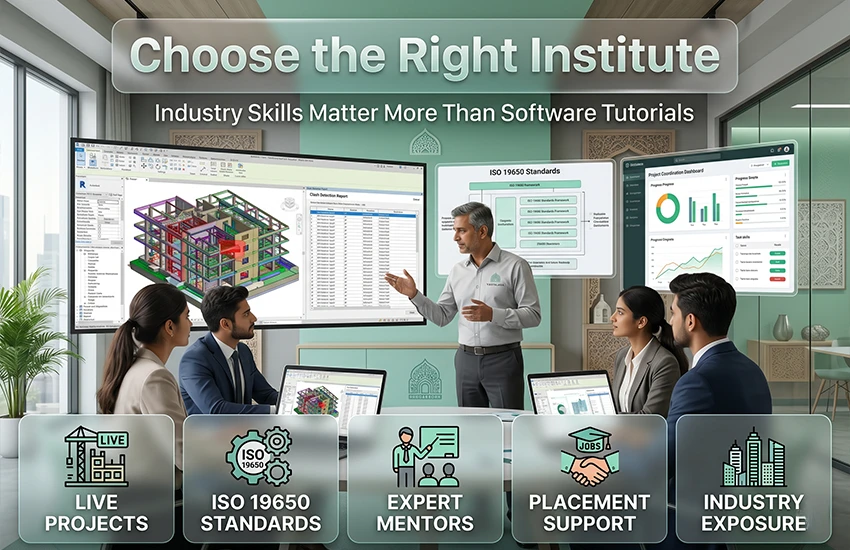
The training industry’s statistics and real-life examples show a lot of hidden challenges that don’t always get revealed by those who work in them. A lot of general-purpose “Software Tutorial Shops” don’t do anything but help students find the right button to push in software like Autodesk Revit or Bentley Systems; they don’t help them create a working model of a project, or work through the resolution of structural conflicts, or manage their project according to the Global standard for managing information (ISO 19650).
Big companies do not want bus drivers; they want people who can create and source solutions to complex engineering problems using the digital world (the way we design, engineer, build, operate, and manage structures today). Students who graduate from an institute that teaches only the command language and how to use the tools will not be able to pass technical evaluations at these companies, regardless of what their certificate says.
So, to properly evaluate the possible best BIM institutes in India in 2026, look beyond the big marketing spins of these organisations. A credible institute will have an authoritative, cross-discipline-based curriculum, with faculty who are practising Consultants in the industry and can provide access to current, verified, live project data sets, as well as a documented, transparent corporate placement record.
Final Verdict
In 2026, a BIM course will probably be worth the financial investment if you keep away from low-quality software companies and you align your learning with industry standards for employment. There’s also that huge chunk of extra income available for BIM-related roles, plus the speed at which companies are hiring employees, meaning more chances to get in early. Selecting an elite training environment, such as Vastulaya, to provide the tools necessary for developing a reduced gap between base theoretical knowledge and the level of project management expertise required by top global companies for the profession will ultimately lead to improved placement opportunities.
Commonly Asked Questions (FAQs)
-
Is the BIM course worth it in India in 2026?
Yes, as the construction industry in India and the Middle East is growing at a rapid pace, the demand for BIM-trained professionals is also increasing every year. The majority of the jobs will require knowledge of BIM (Building Information Modelling), so having this additional qualification will be advantageous in your career.
-
What is the average BIM course fees India?
It can vary between ₹40,000 to ₹1,50,000 depending on the course depth and duration, and the type of placement support provided with your course.
-
What is the BIM course placement rate?
Placement rates can vary based on the institute, student performance, and the current market conditions. Institutes that have established strong partnerships with industry will typically achieve better placement rates for their students than those without such partnerships.
-
What is the average Revit engineer salary across disciplines?
Most students secure a job after completing a BIM training course within 1-3 months of completing their course or during their final stage of completing the program.
-
Which is the best BIM training institute in India in 2026?
The best BIM institute in India 2026 that provides students with the best quality of training for real-world career opportunities in BIM when they finish their studies. One of the institutes that will meet this goal is Vastulaya.
