
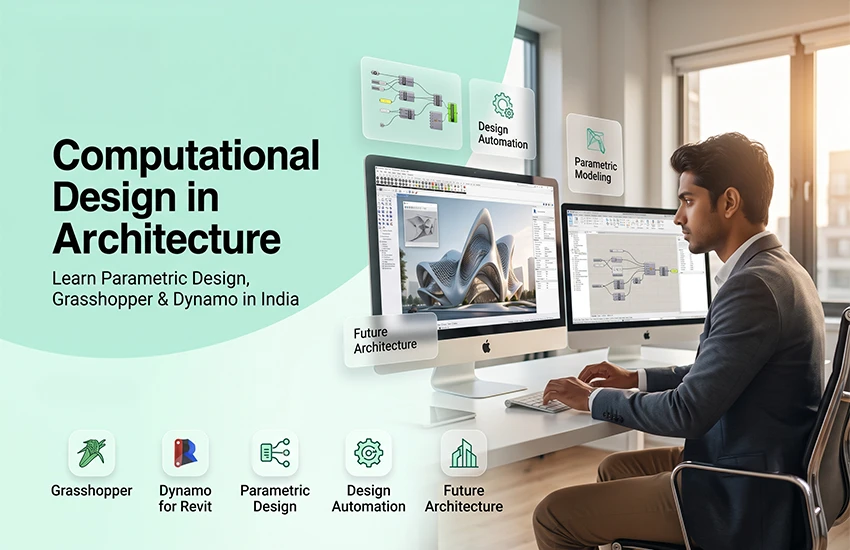
Architecture is developing rapidly, moving away from traditional CAD drafting to a more intelligent, data-driven design. Instead of manually sketching every wall, curve, and facade, architects nowadays are relying on algorithms and rules to create tests and perfect their designs in a matter of minutes. The rise of computational architecture in India is an important development for architects and engineers alike, as projects are becoming more complicated and timeframes more constricted. For students and academics in the field, adapting to this change is no longer optional.

What Is Computational Design in Architecture?
Computational design is the process through which architects define the parameters of their designs and then create automated algorithms that will design the structure for them. It differs from computer-aided design (CAD), which is not an interoperable process, and from building information modeling (BIM), which focuses on actual data rather than actual design.
Thus, architects can create more designs without having to manually draw each version and can apply their work to both CAD and BIM processes, which means that they create a design that won’t change at all, but will yield different versions through the use of an algorithm.
How Computational Design Works
The process usually begins with input information being established, which may refer to specifications of the site, construction limitations, or targets of the design. Then rules and algorithms will be applied on the input, producing the geometrical shape automatically.
The generated shape can be tested for performance and modified through several iterations. Hence, the use of parametric modeling lets change an input parameter that will immediately affect all aspects of the design. At the same time, algorithmic design and automation minimize the amount of human labor needed to conduct the tests in the process.

Core Components of Computational Design
The crucial elements of a computational design procedure include the following components that work together:
- Parameters – The adjustable inputs such as dimensions, site constraints, and material limits that are defined.
- Algorithms and Rules – The logic that transforms the design intention into the rules of steps to follow when carrying out the design.
- Geometry Production – The product of geometry generation that is created based on the defined rules.
- Data and Analysis – The performance metrics from the real world such as daylight, weight on the structure, and consumption of materials in real time.
- Feedback and Iteration – Incorporating feedback to improve and develop the design.
These components create the advantage of computational design over other methods when it comes to speed. Understanding each component, as part of Vastulaya training, each student must learn how everything works together.
Common Computational Design Software Used in Architecture
1.Dynamo in Revit – Dynamo provides visual programming within the Revit environment allowing architects to automate BIM functions without writing complex codes. It is widely applied for automatic documentation, quantity extraction, as well as the automation of repetitive tasks such as creating sheets or updating parameters. For firms interested in speeding up their Dynamo for Revit processes, a good Dynamo for Revit tutorial would be the fastest way to gain confidence in using it efficiently, especially when it comes to parametric design applications.
2. Grasshopper in Rhino – Grasshopper is widely known for free form design and complex geometrical tasks, especially in facade design and organic architecture projects. Being integrated with Rhino, architects can enjoy full control over parametric surfaces, structures, and other unconventional shapes which are otherwise impossible to realize with regular software. Grasshopper is a powerful parametric design tool widely used by architects and designers to optimize facades, automate complex workflows, and solve challenging design problems with precision and flexibility.
Advantages of Computational Design for Architects in India
Some of the key advantages of computational design for architects in India include:
- Faster design iterations and quicker client approvals.
- Less manual modeling and drafting Improved accuracy given complex geometries.
- Increased BIM coordination between disciplines.
- Sustainability in building optimization using data.
- More advanced facade that allows for better designs.
- Data-driven decision-making phase-wise in the design process.
- Increased overall productivity across the entire project timeline.
With the increasing utilization of generative design AEC India, companies can now explore new design options, identify conflicts earlier, and deliver high-quality results in the same or shorter timeframe.
Career Opportunities for People Trained in Computer-Aided Design
While planning about where to study, look for programs that would include education that would cover Dynamo, Grasshopper, and Rhino, all supported by Revit integration and taught in a practical environment, instead of limiting the teaching theory only. Education in a practical way, development of portfolio, and support from industry specialists have the most impact on the level of readiness for job search of graduates.
Certification is good to have; however, it is the work on real projects that employers are interested in. Vastulaya implements programs which ensure combination of education using special tools and working on the projects so that students have a working portfolio instead of knowledge gained from theory only. Vastulaya’s project-based training is built with these exact career paths in mind, so learners graduate with the practical skills these roles demand.
Conclusion
Computational design is quickly transforming into a key knowledge area in today’s architecture, allowing practitioners to shift from manual drafting to automated, data-based workflows. Learning programs such as Dynamo and Grasshopper not only increase daily performance but also provide access to new professional fields such as BIM, design automation, and digital consulting. A well-structured training program and practical exercise such as those offered by Vastulaya are the best ways to get started in gaining these much-needed skills.
Questions People Frequently Ask
-
What does computational design in architecture imply?
Computational design refers to the application of algorithmic and rule-based logic to automatically produce, validate, and refine architectural designs.
-
Is Dynamo superior to Grasshopper?
Dynamo is not necessarily better, as it is and relies on construction processes based around Revit, whereas Grasshopper is used primarily for complex, organic forms in Rhino.
-
What software products are best for computational design?
Some of the most relevant software for computational design include Grasshopper, Dynamo, and Rhino.
-
Can beginners learn the process of computational design?
Yes, it is entirely possible for beginners to learn the process of computational design using structured project-based learning, even if they do not have programming skills.
-
Is there demand for computational design in India?
Yes, demand for computational design is steadily increasing in India.
