
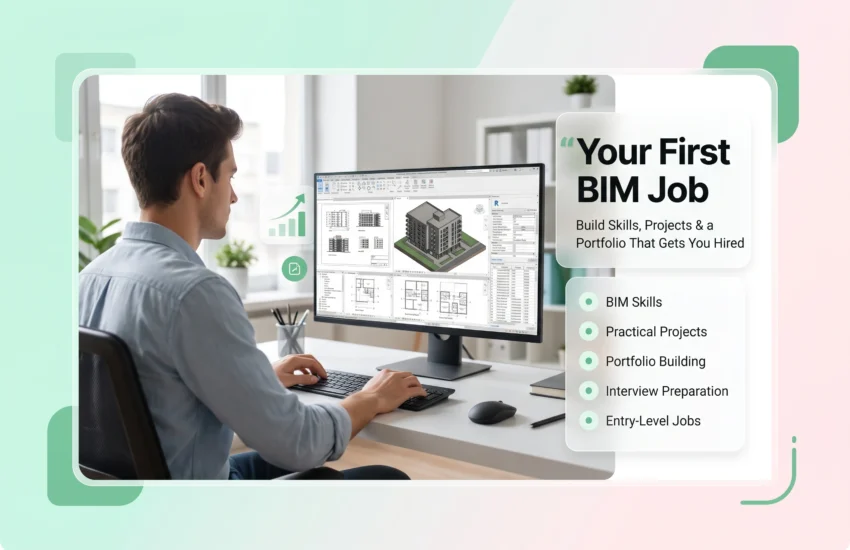
Most of the BIM job descriptions require experience, but how will a fresher gain experience if he doesn’t have a job? The solution to this issue lies in showing employers what you can really do. Practical projects, knowledge of BIM software, a good portfolio, and effective interviewing skills can serve as evidence of job readiness even in the absence of work experience.
The positive side is that recruiters assessing candidates for BIM jobs without experience or for freshers do not consider only years of working experience but practical knowledge in the field of BIM, project works, quality of the portfolio, skill in using the software, and problem-solving skills. Vastulaya recommends existing career advice for BIM positions focused on these very aspects.
Can You Get a BIM Job Without Experience?
Yes, there are BIM jobs for freshers and other entry-level job openings. An employer that hires freshers will assess the capability to create rather than just depend solely on the number of years of work experience.
Creating a great BIM career out of nowhere needs realistic expectation. This means one shouldn’t apply immediately for a BIM Manager or even BIM Coordinator but apply to entry-level jobs with tasks that include modeling, documentation, and technical assistance.
For Vastulaya, a good fresher profile should have knowledge in software and an example of applying this knowledge. Certification will help, but it is not an alternative to capability. The same BIM career advice at present requires creating deliverables and practical workflows in the portfolio.
What BIM Jobs Can Freshers Apply For?
The fresher candidates must aim for practical BIM jobs for freshers, and not for coordination or management roles.
- BIM Modeler – A BIM Modeler prepares and develops BIM models by using architectural, structural, or MEP information.
- Junior BIM Modeler – A Junior BIM Modeler usually assists in developing models and documentation, guided by experienced team members.
- BIM Engineer – BIM Engineer jobs for freshers can include modeling, documentation, coordination, and workflow processes, depending upon the discipline and the organization.
- Revit Modeler – Jobs for Revit freshers usually require developing models, views, drawings, and schedules.
- Junior BIM Technician – A Junior BIM Technician can help with drafting, modeling, documentation, and technical assistance.
Jobs such as BIM Manager or BIM Coordinator should not be considered realistic first jobs.
Steps To Get Your First BIM Job As a Fresher With No Experience
- Learn The Correct BIM Software – Start learning Autodesk Revit first and then add Navisworks and AutoCAD. It is good to be aware of BIM collaboration software but not essential. Dynamo is also an advanced tool to learn, but it will come later. The main goal of BIM training for beginners should therefore be practical competence, not simply collecting software names.
- Build Practical BIM Projects – Complete two to three projects, residential buildings, commercial buildings, and MEP projects. Make sure you cover the whole workflow including views, drawings, schedules, families, documentation, and quality checks, rather than just final outcomes like screenshots. Tutorials are not going to show you BIM project experience.
- Create A BIM Portfolio – Add 3D model screenshots, floor plan, sections and elevations, families, schedules, results of clash detection, model coordination, project description, and your contribution to the project. A BIM portfolio for freshers is one of the most differentiating things in the process of hiring now.
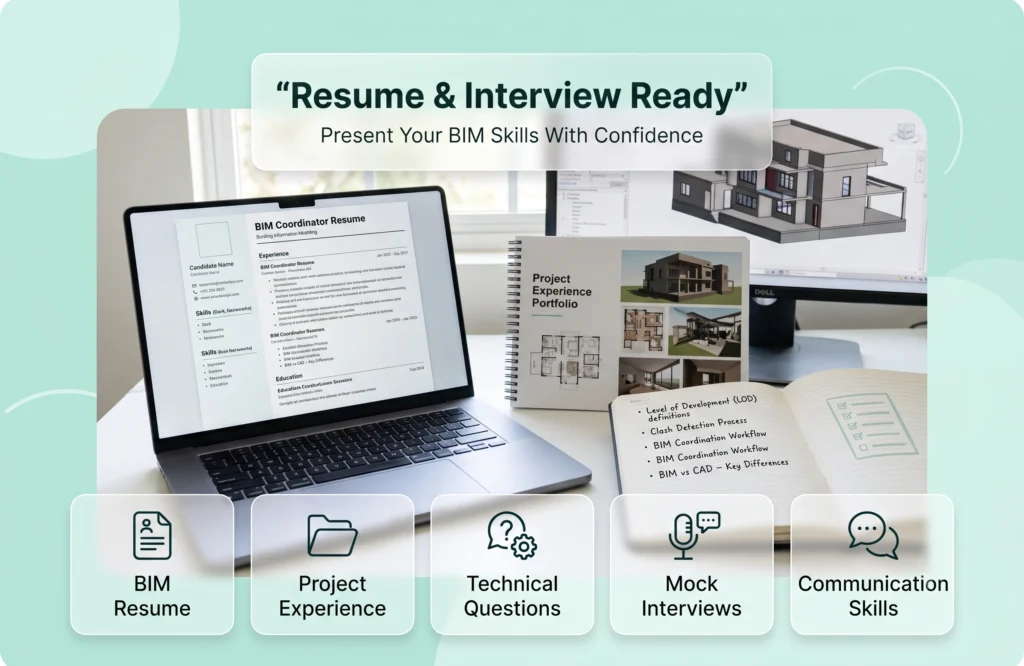
- Create A BIM CV – The important thing is that your BIM resume for freshers should highlight your skills from the start.
The structure to follow would be:
Skills → Software → Projects → Certifications → Education → Portfolio
Do not write “no experience”. Write “Academic/Personal BIM projects” and describe your projects in detail.
That means that you should specify software used, type of building modeled, documentation made, etc.
5. Gain BIM Experience Without a Full-Time Job – For those asking how to earn BIM experience without a job, think of these options:
- Internships
- Academic assignments
- Projects as freelancer
- BIM projects personally initiated by the candidate
- Apprenticeship
- BIM training assignments
- Real BIM project collaborations
The key here is the truth. Personal, academic and training assignments will allow freshers to prove BIM experience, but it cannot be claimed to be job experience.
6. Prepare for BIM Interviews – Getting prepared for answering BIM interview questions is very important. Some of these questions could be:
- What is BIM?
- How does BIM differ from CAD?
- What is Revit?
- What is clash detection?
- What is LOD?
- What is BIM coordination?
- How do you create a family in Revit?
- What do you do with model errors?
- Describe your BIM project.
At Vastulaya, we suggest getting prepared to answer questions project-wise, rather than just saying, “I know Revit”.
7. Apply Strategically for Entry-Level BIM Jobs -Don’t limit your search to “BIM Engineer” alone. Different companies have used various terms for positions carrying similar tasks.
Here’s what you can try:
- BIM Modeler
- Junior BIM Modeler
- Revit Modeler
- BIM Trainee
- BIM Technician
- BIM Engineer
This may lead you to find more BIM fresher jobs and BIM graduate jobs.
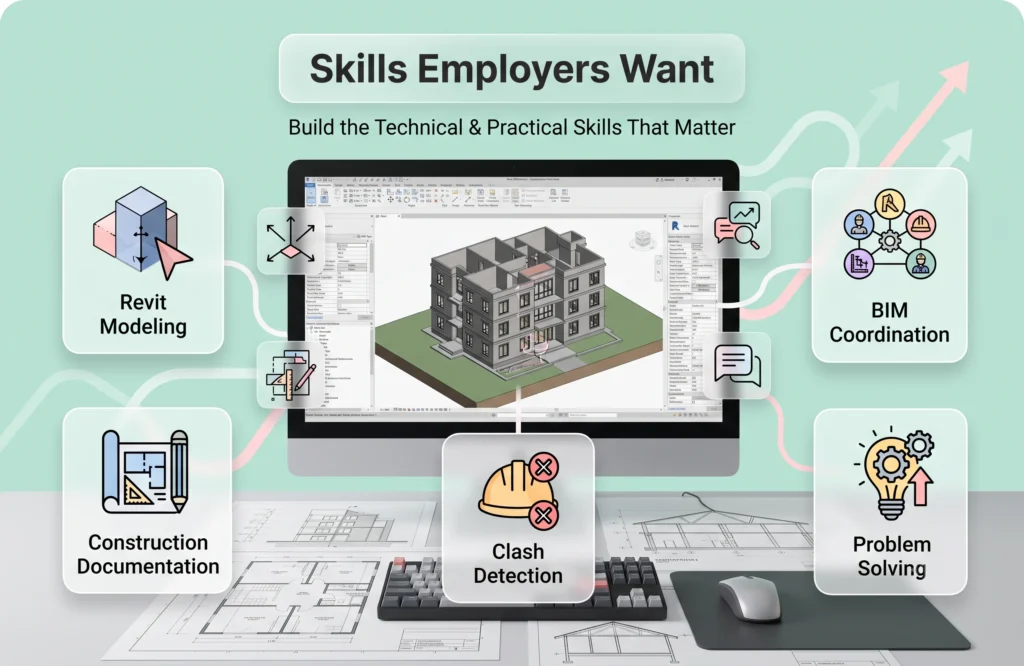
What Skills Do Employers Look for in BIM Freshers?
| Skill | Why It Matters |
| Revit | Core BIM modeling and documentation |
| AutoCAD | Reading and drafting drawings |
| Navisworks | Model review and clash detection |
| BIM coordination | Understanding multidisciplinary workflows |
| Construction documentation | Producing usable project drawings |
| 3D modeling | Building accurate models |
| Communication | Working across project teams |
| Problem-solving | Resolving modeling and coordination issues |
When supported by portfolio evidence, these BIM skills for freshers become much stronger.
Do You Need a BIM Certification to Get a Job?
A BIM certification for beginners may indicate structured learning and initiative, but it must not be taken as a replacement for the practical skills aspect of it. The best way to make your job profile better includes all of the following elements:
Certification + Portfolio + Practical Skills + Interview Preparation.
BIM Training for Beginners course at Vastulaya offers you certification along with practical projects, which will enable you to develop a really good portfolio that is needed to get hired.
How to Build a BIM Portfolio Without Professional Experience
- Make Sure You Include Realistic Project Scenarios – It is essential to make projects similar to real work in AEC and not just exercises within software only.
- Showcase Your BIM Process – Show the whole cycle of work starting from modeling and up to documentation and coordination.
- Include Drawings and Documentation – Provide drawings and documentation plans, sections, elevations, schedules.
- Clash Detection and Coordination Process – Show how clash detection and coordination can be performed with the help of Navisworks.
- Problems You Have Resolved – Describe problems you have faced, the way you have resolved them, and their results.
Common Mistakes BIM Freshers Should Avoid
Some common BIM fresher mistakes can be learning software tools alone, not having any portfolio, having many unrelated skills, mentioning any fictitious experience, applying for senior positions alone, having no knowledge of construction, having no interview preparation, and sending the same resume to everyone.
According to Vastulaya, it is important to customize your resume and portfolio for each relevant job.
30-Day BIM Job Preparation Plan
Week | Focus |
Week 1 | Revit and BIM fundamentals |
Week 2 | Build a practical project |
Week 3 | Portfolio and resume |
Week 4 | Interview preparation and job applications |
This gives you a practical solution as to how to land your first BIM job and kick-start your BIM career without any experience.
Conclusion
Getting your foot in the door to become a BIM professional even if you lack experience is not simply a matter of someone offering you an opportunity; it involves gaining the necessary software skills, experience, and portfolio to make the “lack of experience” argument fall flat on its face.
Freshers who have adopted the right approach and follow it from Revit training all the way to actual interview questions have proven to get their entry into the ranks of BIM modelers and BIM engineers quicker than those depending solely on certification.
Questions People Frequently Ask
-
Can I get a BIM job without experience?
Yes, freshers usually get an entry-level BIM job with great project work and a good portfolio without experience.
-
Which BIM job is suitable for freshers?
Entry-level positions such as BIM Modeler and Junior BIM Modeler are very realistic and common.
-
Is Revit enough for a BIM job?
No, Revit is required but it is not enough. Knowledge of AutoCAD, Navisworks, and BIM coordination is very useful for candidates.
-
Do I need to be certified in BIM for getting a job?
Yes, it can help to show that the candidate is initiative, but it should be complemented with a practical portfolio and the preparedness to pass an interview.
-
How to create a portfolio as a fresher without any experience?
It requires completing at least two to three realistic personal or academic projects and documenting the entire process including models, drawings, clash detection, and participation in all these processes.
-
What should I include in the BIM resume as a fresher?
Skills, used software, personal or academic projects, certifications, education, and portfolio links to your BIM projects should be referred to as "Academic/Personal BIM Projects".
-
What skills do BIM companies require from freshers?
Knowledge of Revit, AutoCAD, Navisworks, BIM coordination, construction documentation, 3D modeling, communication skills, and problem solving.
-
How to prepare for a BIM interview?
Study key concepts (BIM vs. CAD, LOD, clash detection, coordination), be able to present your project, and describe the way you solve certain modeling issues in the process of working with this project. Most courses on BIM training include mock interviews.
