
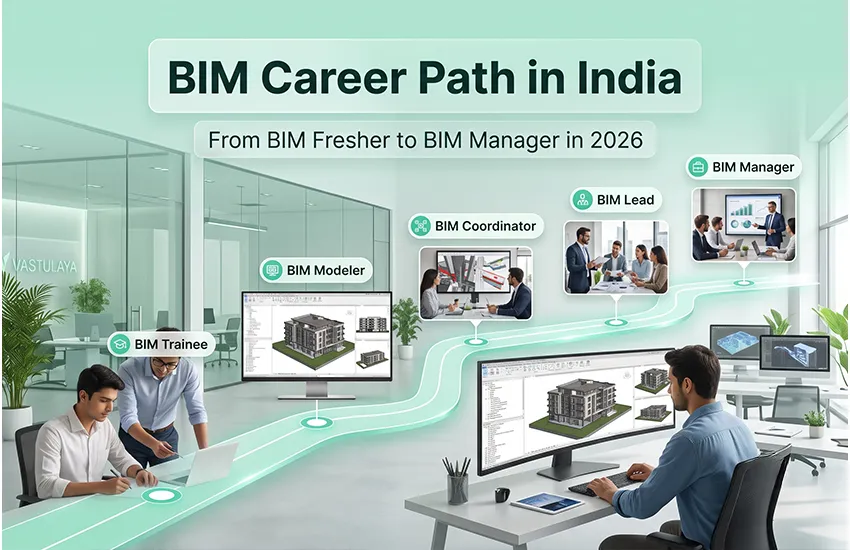
Building Information Modeling (BIM) has transitioned from being seen as a specialized skill to one that is essential in the construction sector in India. With more government infrastructure projects, metro rail expansions, airports, and major private projects needing BIM workflows, the need for skilled BIM professionals has accelerated and outpaced the supply of talent. This could mean a stable, lucrative career path for civil engineers, architects, and diploma holders entering the AEC industry.
At Vastulaya, we come in at various stages of this journey, from students who are learning Revit to engineers about to move into BIM management positions. This article explains the overall BIM career structure in India: what each job entails, which skills and software to have in every stage, expected salaries in 2026 as well as mistakes that hinder most beginners.
What is a BIM Career
BIM stands for Building Information Modeling, which is the technique through which digital copies and replication of a structure’s physical characteristics is achieved. Unlike the traditional method of 2-dimensional drafting, a BIM model contains lots of critical information about the project such as materials used, expected expenses, and the schedule for the whole construction process. A BIM career is therefore not a simple “3D modeling job”; it is a career that is all about managing this information from the start of the project to the end.
Why do companies prefer BIM specialists?
Construction and design companies tend to hire selected BIM workers because of the advantages that come with BIM technology. These advantages include less design interference, more accurate cost estimates, and quicker approvals for the project. This also refers to why more companies prefer to hire full-time BIM employees instead of having their 3D model workers do the BIM work.
Industries that use BIM technology these days: Architecture & Engineering companies, mechanical, electrical, plumbing contractors, building contractors, infrastructure developers, etc. At Vastulaya, we’ve seen this shift firsthand, in which nearly every client project we support today has a BIM component, where five years ago it was optional. That shift is exactly what’s driving the hiring demand this guide is built around.
Is a Career in BIM Beneficial in India?
The Market demand for BIM professionals in India has risen consistently as many construction firms start to shift from traditional CAD-based methods of working. Companies that compete for huge contracts now see having BIM experience as a basic requirement that cannot be overlooked.
Government programs such as laws regarding the use of BIM for some state construction works have forced the contractors to create their BIM departments leading to a demand for hiring people.
BIM outsourcing is another important factor. Many Indian companies have begun to provide BIM services to companies in such countries like the US, UK, Middle East, and Australia which imply that the demand for BIM professionals is not limited to the local market.
Career stability as BIM skills can be used in all types of construction such as residential and commercial, an expert doesn’t depend on the hiring market of any one sector. Vastulaya sees more engineers actively choosing BIM training overstaying purely in traditional design or drafting roles, where the skill set is far more sector dependent.
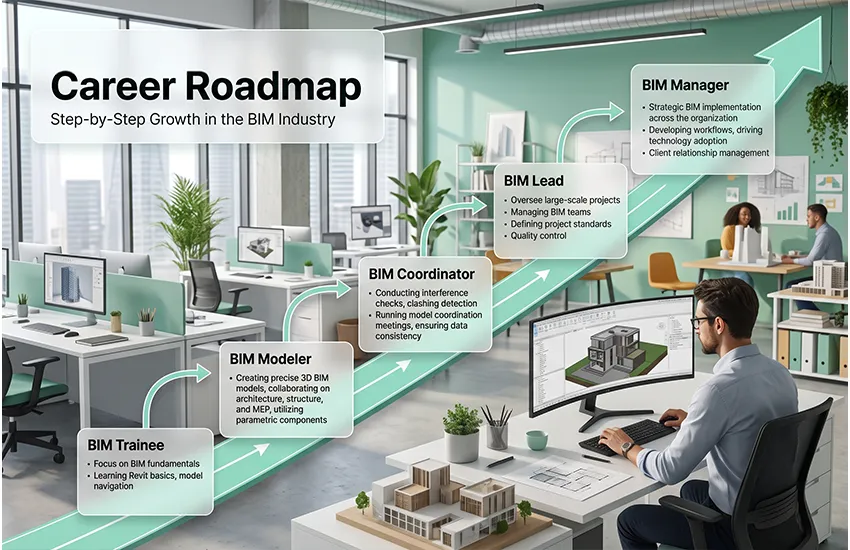
The Step-by-step BIM Career Roadmap
BIM Trainee
- Responsibilities: A BIM intern performs tasks like assisting experienced modelers, gaining knowledge on how to interpret architectural specifications and develop elementary 3D models while being guided by his or her senior colleagues.
- Skills Required: Basic knowledge of Revit and construction drawings and the ability to learn while performing tasks are required.
- Expected Salary: 2.5-4 lakh rupees a year based on the company and region.
BIM Modeler
- Activities: The main duties of a BIM modeler include creating models of architectural and structural elements or MEP systems in Revit, modifying the existing models as changes in project design occur, and working with senior colleagues.
- Software: The work here revolves around the use of Revit, but AutoCAD and some features of Navisworks can be used as well when it comes to preparing reference drawings and checking the models.
BIM Coordinator
- Responsibilities: A BIM coordinator is responsible for coordinating the integration of various models created in different disciplines and ensuring that everyone works on the same data.
- Detecting problems: Another essential duty includes carrying out clash detection to identify conflicts before the construction begins.
- Team Collaboration: Coordinators serve as a communicating link between modelers and site design managers.
BIM Lead
- Team Management: The BIM Lead is responsible for leading modelers and coordinators working on one or multiple projects, assigning them tasks and ensuring the quality of their model.
- Project Completion: The BIM Lead has a responsibility to make sure that the project deadlines and client specifications are delivered properly as planned.
- Client Communication: BIM Leads communicate directly with clients or other stakeholders/providers to interpret the technical jargon of BIM into actionable insights for non-technical participants.
BIM Manager
- Strategic Planning: The role of a BIM Manager is to develop policies and procedures on the level of the whole organization or at the level of the project portfolio, rather than at the level of a single project.
- BIM Implementation: This includes implementation of software, templates and procedures on the level of different teams and making the most significant decisions about how to continue evolving the BIM implementation in the coming years.
- Leadership Responsibilities: BIM Managers report to the top management, manage BIM-related expenses and are the ones who are on the part of bringing Vastulaya to the organization from the standpoint of training people for working with BIM in the organization.
Skills Required at Every Career Stage
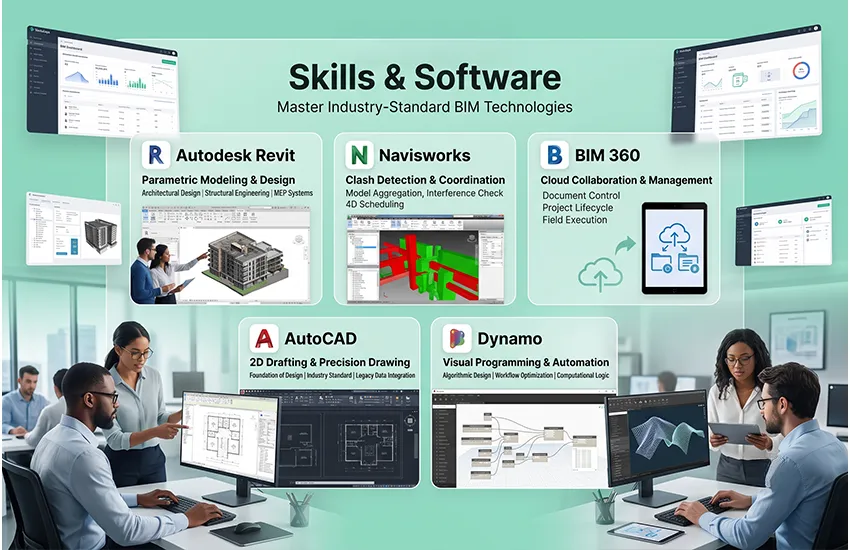
Skills associated with different levels of experience vary in terms of complexity and importance when working in BIM. While junior roles focus on software skills, senior positions require skills involving communication, coordination, and experience. Vastulaya builds its training around this development. Software involving drafting and modeling includes:
- Revit – Software used in architecture, structural engineering and MEP works from the start of your career in BIM.
- Navisworks – A must-have software solution for clash detection and project review for the role of Coordinator.
- AutoCAD – A widely used tool for reference drawings.
- BIM 360 / ACC – New platforms used for model sharing.
- Dynamo (basic level) – Programming language used for automating repetitive tasks.
- Communication – Learning to communicate is as important as becoming proficient in software. Coordination – Ability to deal with contributions from different disciplines.
- Problem-solving – Ability to detect and solve problems in design before construction.
Education Qualification
The educational background allows various individuals to take BIM career in India:
- Most candidates in structural BIM are civil engineering graduates.
- Architecture graduates mostly have jobs in architectural BIM or design coordination.
- Mechanical engineering graduates generally focus on MEP modeling.
- Electrical engineering graduates can also work in electrical BIM processes.
- Even graduates with diplomas in civil, mechanical or electrical engineering might find jobs in BIM after specialized training programs, like the ones provided by Vastulaya, which hone practical skills instead of requiring a full engineering degree.
Conclusion
The BIM career path in India moves from Trainee to Modeler, Coordinator, Lead, and BIM Manager, each stage needing the combination of software skill, construction competency, and ability to coordinate. Thanks to the rising demand from the realms of infrastructure, architecture, and industrial construction, BIM is one of the most future-proof careers within the AEC industry today. As far as newcomers are concerned, the combination of practical involvement with theoretical training, as it is done in Vastulaya’s development programs, allows moving faster along the chart.
Questions People Frequently Ask
-
Is BIM a good career in India?
Yes, BIM is in high demand with abundance of opportunities in the construction industry, architecture, and infrastructure. An increase in the projects executed in India has given birth to many jobs in BIM.
-
How long does it take to become a BIM Manager?
Typically, professionals take around 8-12 years to acquire the skills required for this job. But with structured training like that provided by Vastulaya, the training period is reduced.
-
What is the best engineering branch for BIM?
Candidates from civil, mechanical and electrical engine especially in design roles.
-
Is it possible to find a job as a freshman at BIM?
Yes, fresh candidates usually begin their careers as BIM trainees or modelers. If one has a great portfolio and formal training like Vastulaya’s, then it is easy to get hired.
-
Which BIM software should I start learning?
You should begin with Revit, as it is the basic software you will be using at all stages of your career. You can then move onto Navisworks and BIM 360.
