
Table Of Contents
India’s infrastructure sector is going through its largest digital transformation yet, and Building Information Modeling (BIM) is right in the middle of it. From metro rail corridors in Delhi to smart city work in Pune, and waterfront developments in Mumbai, BIM tech for infrastructure is basically not optional anymore; for civil engineers, it is now the baseline expectation.
If you’re a civil engineering graduate, a working site engineer, or a design professional trying to future-proof your career, joining a BIM course for civil engineers in India in 2026 is one of those highest-ROI decisions you can really make. This guide by Vastulaya takes you through the full story too, like what to learn, where to learn it, what it costs, and the career outcomes you can actually expect.
Why Civil Engineers Must Learn BIM in 2026
The Architecture, Engineering, and Construction industry is steadily moving away from standard 2D drafting toward a more connected, digital set of workflows. For civil engineers, it basically means that knowing AutoCAD alone is no longer enough if you want to be considered for senior positions, whether you are working with an Indian EPC contractor, a Gulf infrastructure team, or a European consultancy.
BIM lets professionals design, analyse, test scenarios, and then manage a project inside one 3D model that is enriched with real-world information. That model can include structural grids, reinforcement schedules, construction sequence logic, and even facility management handovers. People who truly get BIM often say they see quicker delivery cycles, fewer mistakes on site, and yes, a clearly stronger pay trajectory.
At Vastulaya, our in-house BIM engineers use these tools every day on real infrastructure and commercial projects. And the need for certified BIM professionals with our project partners has increased by more than double since 2024.
What Does a BIM Course for Civil Engineers Cover?
A good BIM course for civil engineers in India really goes further than just software training. It is not only about clicking in tools; you need a proper pathway, with practical thinking, and yeah, a few real-world workflows. Here’s how a full 2026 curriculum should look, without getting too neat or too rigid:
- BIM basics and working method: BIM methodology, ISO 19650 standards, BIM Execution Plans (BEP), and Level of Development (LOD 100–500), the whole idea of what “ready” means in a model
- Autodesk Revit Structure: Structural modelling, reinforcement and rebar detailing, component families, sheet setup, and annotation workflows that feel usable on project days
- Navisworks: Clash detection, 4D construction sequencing, and coordination reports that do not just print results but actually guide decisions
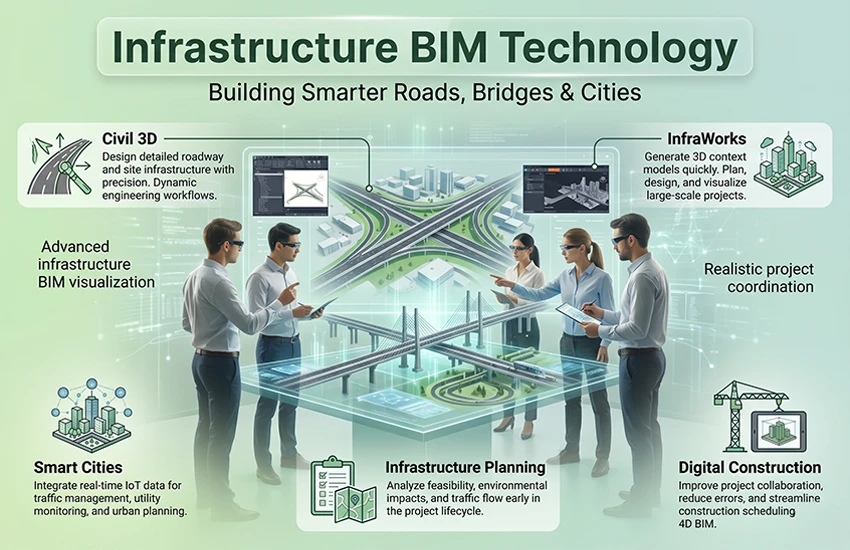
- Civil 3D / Infraworks: Road alignments, grading, site design, plus infrastructure BIM for realistic civil deliverables
- Tekla Structures: Advanced modelling for structural steel and precast concrete, including the kind of precision people expect in industry
- BIM dimensions (4D, 5D, 6D, 7D): Time planning, cost tracking, sustainability inputs, and FM data integration, all connected, not separately
- Scan to BIM: Point cloud capture, processing, and model generation for renovation projects where conditions are messy and existing data matters
- BIM coordination: Multi-discipline federated models, clash reports, and issue resolution steps that keep everyone aligned
- AI inside BIM: Generative design, automated clash prioritisation, and data analytics integration, so outcomes get smarter rather than just bigger
When you’re checking out any BIM course, ask if the curriculum has a live capstone project included. Doing work on an actual model, not merely textbook exercises, that’s what really separates job-ready BIM people from those who only learned in the classroom.
Types of BIM Courses Available in India (2026)
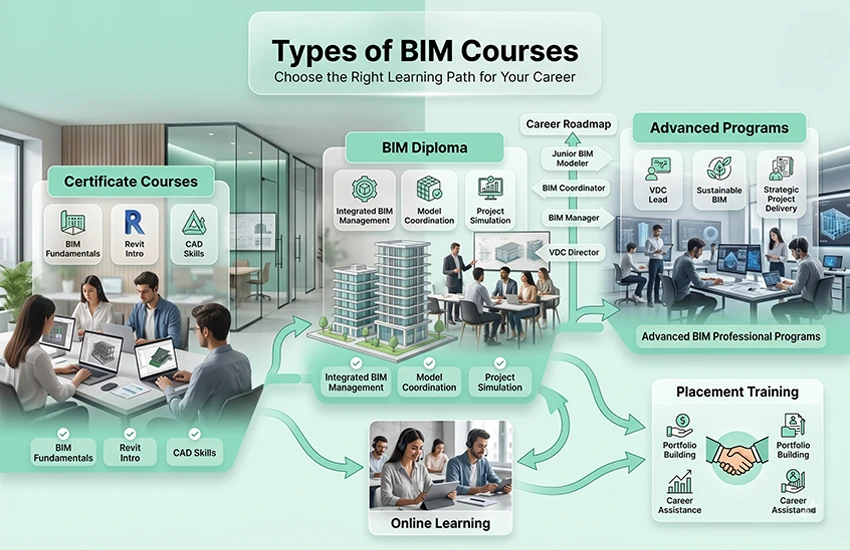
- BIM Certificate Course (3–6 Months) – Training that’s really focused on a specific tool, like Revit Structure or Revit MEP. It’s meant for working professionals who want to add BIM to what they already know, without taking a long break. Most of these are online BIM courses in India, so you can join from basically any city.
2. BIM Diploma Course India (6–12 Months) – Honestly, this is one of the most popular formats among civil engineering graduates. A BIM diploma course in India usually goes into Revit, Navisworks, Civil 3D, and also the whole project coordination workflow in a detailed way. You can find lots of institutes in Delhi and Hyderabad that offer the same course, plus placement support, and sometimes even small mentoring sessions. Vastulaya suggests this diploma-level training for anyone who is aiming toward BIM Coordinator or BIM Manager roles in about 1–2 years.
3. Masters / Post-Graduate BIM Programme (12–18 Months) – A mix of comprehensive programmes run by a few engineering colleges and also private institutes, so it can feel a bit scattered, but it still covers BIM across structural, MEP, and civil infrastructure, basically all the key domains. Alongside that, the curriculum often includes modules on BIM governance, digital twin technology, and how AI integration comes into the workflow. This one is most fitting for engineers looking to step into senior roles, like BIM Manager or BIM Consultant, typically at big EPC firms, and international consultancies too.
BIM Institute in Delhi: Why the Capital Leads
Delhi NCR has become the most powerful hub for BIM training for civil engineers in India. There’s this heavy presence of big EPC contractors, government infrastructure teams, and even international consultancy offices around Gurugram, Noida, and Central Delhi, so naturally, the need for BIM-certified engineers keeps rising, and the whole training environment basically followed it.
If you are looking for a BIM course for civil engineers in Delhi, then you should check a few things before you just enrol, because not every institute is equally serious. A quality BIM institute tends to show this pattern:
- First, the curriculum should match Autodesk Revit, Navisworks, and Civil 3D; these are the three platforms that most Delhi-NCR employers keep asking about.
- Second, the faculty should have real-life project exposure, not only academic or theory-heavy backgrounds.
- Third, there should be a placement cell that can show documented links with EPC firms, PMC companies, and government BIM vendors; it’s mostly just claims.
- Also, look for batch sizes that are not overcrowded, like under 20 per batch, so you actually get hands-on software time.
- Make sure there is a campus BIM lab with licensed software and enough hardware, because using limited systems kills the learning pace.
- And yes, you should expect extra modules on BIM technology in infrastructure, because Delhi Metro, RRTS, and Smart Cities type work needs that extra context and workflow clarity.
Vastulaya is a BIM institute in Noida offering an updated curriculum that matches the current demand of the market. Our team can help civil engineers in Delhi pursue the BIM course in Delhi for their own career path, whether you’re aiming at infrastructure, commercial buildings, or MEP coordination.
Career Scope after a BIM Course for Civil Engineers
So after someone finishes a legit BIM course for civil engineers in India, the career outcomes are usually pretty strong, especially inside the AEC sector. You can expect a sort of progression path that usually goes step by step.
|
Role |
Experience |
Avg. Salary (India) |
Key Skills |
|
BIM Modeller |
0–2 years |
₹4–7 LPA |
Revit, AutoCAD, Navisworks |
|
BIM Coordinator |
2–4 years |
₹7–12 LPA |
Clash Detection, Federated Models |
|
BIM Engineer |
3–5 years |
₹10–16 LPA |
Tekla, Civil 3D, 4D/5D BIM |
|
BIM Manager |
5–8 years |
₹16–28 LPA |
ISO 19650, BEP, Team Management |
|
BIM Consultant / Director |
8+ years |
₹28–50 LPA+ |
Digital Twin, AI, Strategy |
Beyond India, BIM-certified civil engineers from India are really in demand in the UAE, Saudi Arabia, Qatar, the UK, and Australia, where Vastulaya’s global BIM service network actually works. Engineers who can do structural BIM and also understand infrastructure workflows are regularly put on Gulf projects, and their compensation packages come in well above typical Indian market rates.
Conclusion
2026 feels like the right moment to start, or even to sharpen, your BIM career. Since infrastructure projects keep ramping up and BIM adoption spreads worldwide, certified civil engineers are being asked for more and more. So whether you pick online BIM training or you go offline with a classroom program, practical learning really matters, not only theory.
Vastulaya helps aspiring professionals by offering industry-driven BIM education, real-life project exposure, plus career direction, so civil engineers can grow and succeed as the AEC industry keeps changing.
Questions People Frequently Ask
-
What is the best BIM course for civil engineers in India in 2026, really?
It depends on where you are in your career, honestly. If you’re a fresh graduate, a 6–12 month diploma-type programme is usually the better route, with some live project exposure, plus placement support, so you don’t feel stuck later. For those already working, shorter online BIM certification courses can work nicely too. Vastulaya basically recommends courses that are more industry aligned, not just “watch and move on” training.
-
Is an online BIM course enough for civil engineering jobs in India?
Online BIM learning can help a lot with certifications and quick skill upgrades. But in most cases, recruiters tend to prefer structured offline or hybrid programmes, especially those that give real-life project exposure. So, online is good, but the “how much practice” matters more.
-
What software is usually taught in a BIM course for civil engineers in Delhi?
Most courses cover Revit Structure, Navisworks, Civil 3D, Tekla Structures, and InfraWorks. If it’s an advanced track, they might also include Bentley tools, and in some programmes even AI-assisted BIM workflows, depending on the curriculum.
-
How does BIM technology for infrastructure differ from building BIM?
Infrastructure BIM is more about roads, bridges, tunnels, and utilities, so tools like Civil 3D and InfraWorks are commonly used. Building BIM is mostly about architectural and structural modelling, where Revit ends up being the core platform for a lot of work.
-
Which is the best BIM institute in Delhi for civil engineers?
The best institutes typically train you on Revit, Navisworks, and Civil 3D, and they also include live projects and placement assistance. Vastulaya helps engineers narrow down a BIM programme based on career targets, plus budget reality.
