
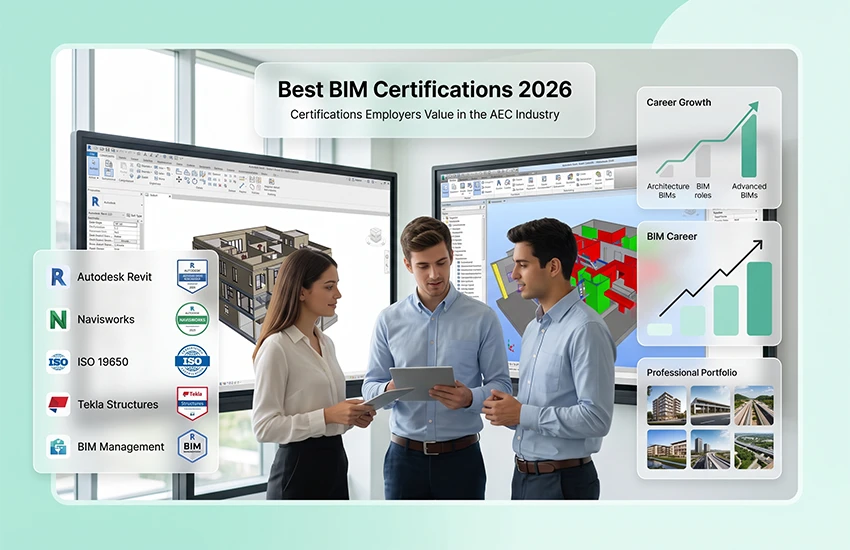
Building Information Modelling (BIM) plays a major role in the implementation of construction projects as the industry has already caught the digital wave. Even though having practical experience with BIM is important, the most efficient certification programs allow employers to evaluate whether the candidate has the required knowledge. Certified specialists are of the higher value as they proved their competence through assessments rather than just making a statement in a resume. Therefore, companies in the fields of architecture, engineering, and construction are prioritizing workers who have BIM certification.
If you are planning to advance your BIM career, read this guide for detailed information about the top BIM certification programs, selection methods, and the role of training institutions such as Vastulaya in your learning
Are BIM Certifications Worth It?
Yes, for most people working in the AEC industry, BIM Certifications is worth it. Hence, getting the Best BIM certification pays off in multiple ways:
- Better Job Prospects – During the recruitment process employers use certification as a filter while searching for candidates, for instance, for BIM coordinator and BIM modeler positions.
- Bulging Salary – Certified BIM specialists tend to have a higher income than non-certified ones, regardless of their work background.
- Trustworthy Credentials – One’s certification means that clients and employers can be assured in the candidate’s professional competence.
- Better Project Knowledge – Obtaining the certification means that the candidate has better insight into the whole mechanism of the project workflows, standards, and logic behind using software for project development.
Read More – How to Learn Computational in Architecture
Why do companies prefer BIM specialists?
How to Choose the Right BIM Certification
Choosing the right certification in Building Information Modeling (BIM) means selecting a qualification that aligns with your professional goals, rather than simply opting for a well-known or popular certification. Before finalizing which program to go for, there are a few things that you should consider.
- Career Goals – Determine if you wish to focus on the area of BIM modeling, coordination, documentation, or if you want to specialize in management of BIM.
- Software Specialisation – Ensure that your choice of certification corresponds with the software used in your career, e.g. Revit, Navisworks, Bentley or any other programs.
- Industry Demand – Conduct research to find out what type of certification is in demand in the labor market and what software skills are considered the most valuable by employers.
- Budget and ROI – Compare expenses related to courses, as well as expenses for taking the exam, to what type of skills and potential for employment the program could give you.
- Duration of the Program – Analyze the length and timing of the program and see if it fits your schedule.
- Practical Exposure – It is recommended to choose programs that provide students with real working experience.
Institutions like Vastulaya formulate the organization of BIM programs based on these principles and, therefore, directs learners in selecting the right certification depending on their background and career aspiration. Instead of acquiring a random credential, having the correct BIM credential can pave the way toward obtaining the necessary skills and enhancing your portfolio to climb the AEC industry ladder.
Top BIM Certifications in 2026
Here’s a closer look at the Best BIM certifications that shapes hiring decisions in 2026:
- Autodesk Certified Professional (Revit) – The Best certification for individuals looking for modeling or coordination jobs that are mid-level and above. It provides in-depth knowledge pertaining to Revit’s advanced modeling, documenting, collaboration, and opens numerous opportunities including those of a BIM modeler, BIM engineer, and BIM Coordinator.
- Autodesk Certified User – This certification is meant for beginners and students starting out in BIM. It provides knowledge of the basic concepts of Revit and helps the freshers to create a credible entry in their resume.
- Navisworks Certification – This certification stresses the need for conflict management and cross-discipline collaboration. This means that this qualification is particularly valuable for specialists completing integration and conflict management prior to the actual construction project.
- BIM Management Certification – This certification targets experts who strive to reach leadership roles. It covers PMI topics, team coordination, and BIM Execution Planning, making it a must-have for future BIM Managers.
- ISO 19650 Awareness Certification – This certification is about international BIM standards, and it is gaining importance for professionals working on international projects requiring data management.
- Bentley OpenBuildings Certification – The Bentley Open-Buildings Certification is for specialists in the domain of infrastructure, especially for those who work in large-scale civil engineering and infrastructural projects using the Bentley platform.
- Tekla Structures Certification – Focuses on structural BIM and is suited for professionals who work on steel and concrete detailing, scaffold coordinating, and ready-to-fabrication models.
Skills Employers Look Beyond Certification
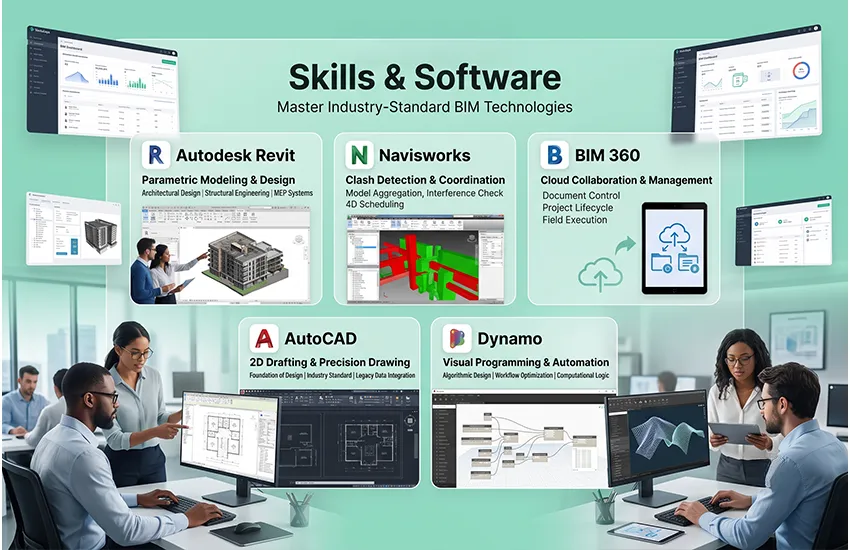
BIM certification can boost your CV, but when it comes to skilled professionals, employers want users who are capable of applying their skills in real-life projects. Besides the formal qualifications, companies look for practical experience in tools like Revit, Navisworks, BIM 360, and AutoCAD, alongside practical skills in clash detection, quantity takeoffs, construction documents, model coordination, and project workflows.
What is equally important, however, is soft skills. BIM professionals often work with architects, structural engineers, MEP consultants, contractors, and clients; therefore, the ability to communicate well, trouble-shoot, collaborate, and pay attention to details is vital for completing the project successfully.
Read More – How to Learn Computational in Architecture
What Documents is Best for Students from Various Engineering Background
The Best BIM certification varies depending on the educational history, job desires, and career objectives of the student. If students choose a discipline-based path towards their career, they can learn the necessary software skills and avoid a potentially wasted time on unrelated certifications.
- Civil Engineers: Autodesk Certified User can be learned, then Autodesk Certified Professional in Revit can be obtained. Basics of BIM workflows should be mastered at the same time, focusing on structural and construction ones.
- Architects: Start with Autodesk Certified Professional in Revit, then go for advanced courses in BIM coordination or management that become necessary as job responsibilities increase.
- Mechanical Engineers: For MEP specialists, Navisworks certification and MEP coordination courses will be of great help in mastering integration of models into work and coordination across different disciplines.
- Electrical Engineers: Navisworks certifications, MEP coordination training and clashes checking qualification make an excellent way to manage complex building service models.
Vastulaya’s certification courses provide trainees with opportunities to follow similar discipline-based approaches and find the right certifications for their future job and educational background.
Certification vs. Practical Experience
Having a certification implies a particular understanding of a certain BIM tool or the workflow of its usage. However, experience suggests knowing how to apply it. The employers need professionals who can function under the constraints of an actual project, interacting with other disciplines, settling conflicts, fulfilling deadlines, interpreting construction specifications, and adjusting to client’s requirements.
This is why learning real and industry-simulated projects is no less important than getting a certification. A well-built portfolio provides evidence of the employee’s work.
The ideal BIM candidates combine recognized certifications, hands-on project experience, technical proficiency, and effective communication. The combination of all creates a professional profile that is better demand in the AEC industry.
Career Opportunities After BIM Certification Program
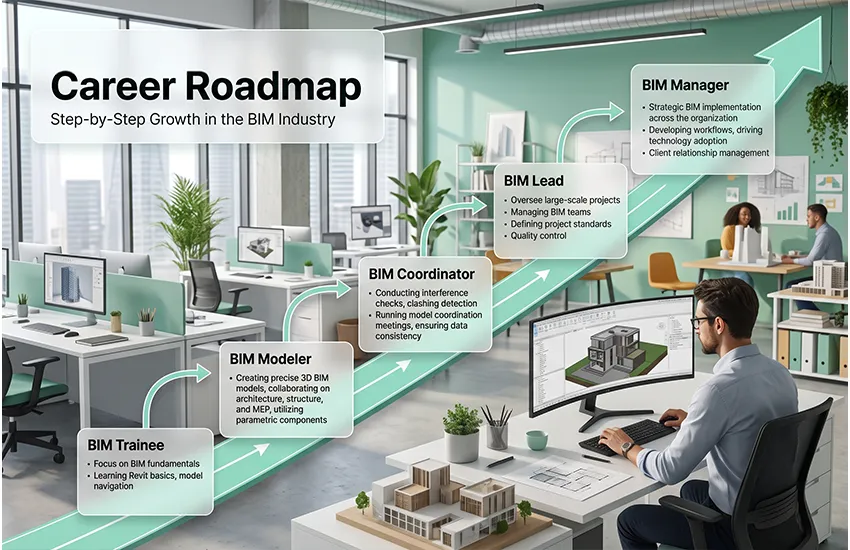
Holding a BIM certification can help you in a variety of career paths related to architecture, engineering, and construction (AEC). With this certification, individuals can become BIM Modelers, BIM Engineers, BIM Coordinators, BIM Consultants, or BIM Managers. After some experience, professionals can gradually take on more advanced responsibilities in their careers, including team management, strategic decision-making, and project management.
How to Prepare for BIM Certification Exams
If you want to prepare well for the BIM certification exam, you should do the following things:
- Use Official Study Materials: Get familiar with what materials the certification body offers about BIM certification, including the exam manual and study guides.
- Work on Practical Projects: Putting BIM concepts into practice either in real-life situations or mock projects will improve your skills tremendously.
- Take Mock Tests: Doing a number of mystery exams will help you understand the exam better.
- Have a Study Plan: Make sure to study regularly each week.
- Focus on Practical Application: It is important to know how to use BIM tools on projects rather than just memorizing theory.
Conclusion
The top BIM certifications can be beneficial for advancing careers, although they deliver optimal results when supported by practical hands-on skills. It is important to select a certification program suitable for one’s career plans, software proficiency, and market demands alongside real practical experience. With its BIM training programs, Vastulaya combines both certification-oriented programs and practical projects.
Questions People Frequently Ask
-
Which BIM certification is considered the best in India?
Among the best BIM certifications in India, the Autodesk Certified Professional (Revit) certification is among the top BIM certifications, earning high respect among employers from AEC companies in India.
-
Is Autodesk certification worth it?
Typically, professionals take around 8-12 years to acquire the skills required for this job. But with structured training like that provided by Vastulaya, the training period is reduced.
-
Can I get a BIM job with only certification?
It is possible to get an entry-level job with only a certification but having it and some practical experience increases chances of finding good employment opportunities.
-
Which certification is best for fresher?
Beginners can think of starting from getting an Autodesk Certified User certificate, then switching to Autodesk Certified Professional certification, as skills improve.
-
How much does a BIM Certification cost?
Prices will differ with the provider as well as the level of certification, so you should compare the official prices before enrolment.
